
Quick answer
Choose a printed coir mat when the entrance is part of your décor and you want colour, a motif or a welcoming focal point. Choose a plain coir mat when you prefer a minimal natural look and want surface wear to appear less design-dependent. Scraping performance depends more on fibre density and construction than on whether the mat is printed.
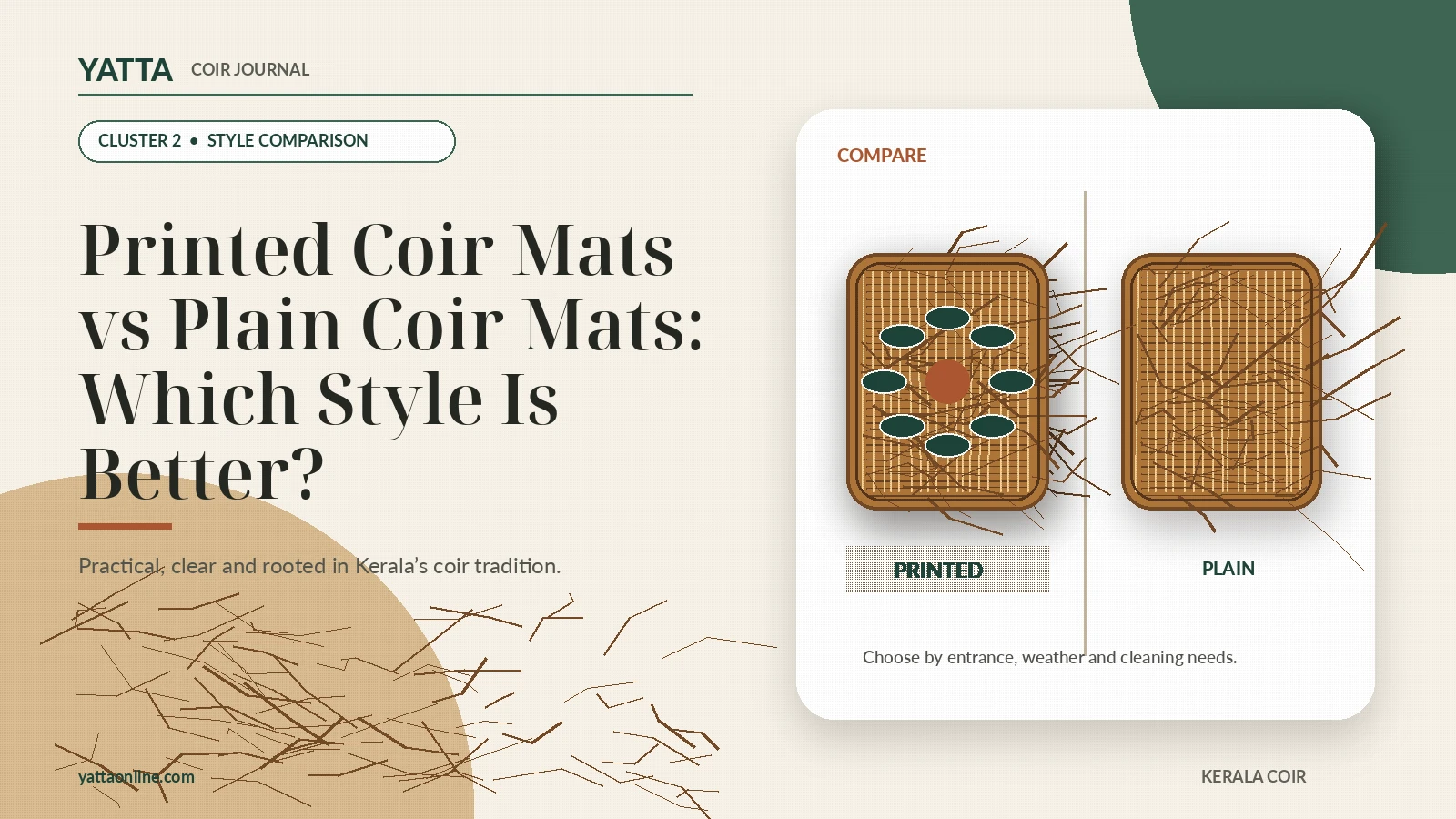
Printed and plain coir mats are made to perform the same basic job: helping to remove dry dirt from footwear. The main difference is visual. A printed mat uses pigments, stencilling or surface designs, while a plain mat highlights the natural coconut-fibre colour and texture.
The right choice depends on your entrance style, sunlight exposure, traffic and how much visible design wear you are willing to accept.
Printed vs plain coir mat: key differences
| Factor | Printed coir mat | Plain coir mat |
|---|---|---|
| Look | Decorative, colourful and theme-based | Natural, minimal and texture-led |
| Design role | Acts as an entrance accent | Blends with many doors and floors |
| Wear visibility | Fading or abrasion can alter the motif | Flattening and colour variation appear more uniform |
| Cleaning approach | Gentle dry cleaning helps protect the surface design | Dry cleaning is still recommended, with less concern about printed details |
| Best location | Covered entrance where the design is visible and protected | Covered entrance, utility doorway or minimalist setting |
| Buying focus | Print placement, colour, contrast and fibre quality | Fibre density, edge finish, backing and size |
| Personalisation | Can feature florals, borders, text or seasonal designs | Usually limited to shape, weave, border and natural shade |
Does printing change how a coir mat works?
A surface print does not automatically improve or reduce dirt scraping. Performance is mainly influenced by the coir fibre, pile height, density, construction and how the mat is used. A heavily coated design could feel different from an open fibre surface, so inspect product photographs and specifications rather than assuming all printed mats are identical.
The design is applied to the top area that receives footwear contact. Over time, friction can soften or fade parts of the print. This is normal wear rather than proof that the underlying mat has stopped working.
Benefits of a printed coir mat
- Adds colour and personality to the entrance.
- Can coordinate with the front door, wall paint, planters or seasonal décor.
- Makes a wide runner feel like part of the home design rather than only a utility product.
- Offers floral, geometric, welcome and regional-inspired options.
- Can help define the threshold in a large entrance.
Limitations of a printed coir mat
- The design may fade with sunlight, moisture and repeated shoe abrasion.
- Strong scrubbing or unsuitable cleaners may affect the printed surface.
- A very specific colour may be harder to coordinate after repainting the entrance.
- Wear can be more noticeable when it occurs unevenly across a detailed motif.
Benefits of a plain coir mat
- Provides a classic natural-fibre appearance.
- Matches a wide range of door colours and architecture.
- Keeps attention on texture, shape and craftsmanship.
- Makes gradual surface wear less dependent on preserving a motif.
- Works well in utility entrances and minimalist homes.
Limitations of a plain coir mat
- May look too simple when the entrance needs a decorative focal point.
- Natural fibre shade can vary and may not match a perfectly uniform colour expectation.
- Without a border or motif, some buyers may see it as more functional than decorative.
Which design suits your front door colour?
| Door or entrance style | Suggested coir mat direction |
|---|---|
| Dark wood door | Natural plain coir or a light floral print for contrast |
| White or cream door | Printed border or warm natural coir |
| Grey modern entrance | Plain coir for warmth or a restrained geometric print |
| Traditional Kerala-style doorway | Natural coir, floral motifs or earthy borders |
| Colourful painted door | Plain coir or a print using one related accent colour |
| Plant-filled verandah | Botanical or floral print with enough negative space to show the coir texture |
Will a printed coir mat fade?
Any colour exposed to strong sunlight, rain and abrasion can change over time. The rate depends on the pigment, printing process, location and traffic. A covered entrance generally protects a printed coir mat better than an open doorstep.
To preserve the appearance, avoid aggressive scrubbing and do not use bleach or strong chemical cleaners unless the care instructions specifically permit them. Rotate the mat only if the design and traffic pattern make rotation appropriate.
Which one hides dirt better?
A mid-tone or multicolour printed mat can visually disguise small dry particles between cleaning sessions, while a very light print may show marks. Plain natural coir also hides some dust because the fibre has colour variation. However, visual concealment is not a substitute for cleaning. Trapped grit should be removed so the fibres can continue to scrape effectively.
Which is better for high traffic?
For very high traffic, choose first by build quality rather than print. Look for suitable thickness, dense usable fibre, secure edges and a stable backing. A plain design may show less obvious pattern wear, but a well-made printed mat can still be practical in a covered residential entrance.
How to choose between printed and plain coir
- Decide whether the mat should blend in or become an entrance feature.
- Check how much direct sunlight and rain reach the doorway.
- Choose a size that visually matches the door width.
- Inspect the product’s fibre density, thickness and backing.
- Select colours that work with the door, floor and nearby walls.
- Read the cleaning instructions before buying.
- Accept that both natural fibre and surface print will show normal use over time.
Final verdict
Printed coir is best for expressive entrance décor; plain coir is best for understated versatility. Neither style is automatically better at scraping. Prioritise fibre construction, size, backing and correct placement, then choose the design that suits your home.
Use the coir mat buying guide to evaluate practical features before deciding on a print.
Frequently Asked Questions
Do printed coir mats lose colour?
The print can gradually fade or wear from sunlight, moisture and footwear abrasion. A sheltered entrance and gentle dry cleaning can help preserve the design.
Is a plain coir mat more durable?
Not necessarily. Durability depends mainly on construction, fibre density, backing, traffic and weather exposure. A plain design may simply make surface wear less visually obvious.
Can I repaint a faded coir mat?
Home repainting may make fibres stiff, produce uneven results or transfer colour. Follow the manufacturer’s guidance rather than applying ordinary household paint.
Are floral coir mats suitable for modern homes?
Yes. Choose a restrained palette, clear negative space and a size that aligns with the doorway. Floral designs can soften a modern grey, white or wooden entrance.
How should I vacuum a printed coir mat?
Use suitable suction and avoid aggressive rotating brushes that pull fibres or abrade the print. Test gently and follow the care label.
Looking for a Kerala coir mat?
A floral coir runner can add a strong visual finish to a wide, covered threshold while retaining the practical texture of coconut fibre. Explore YATTA home and entrance products.
Editorial note and sources
Prepared by the YATTA Editorial Team for practical buyer education. Mat performance varies with construction, backing, traffic, weather exposure and care. Always follow the instructions supplied with the specific product.