
Quick answer
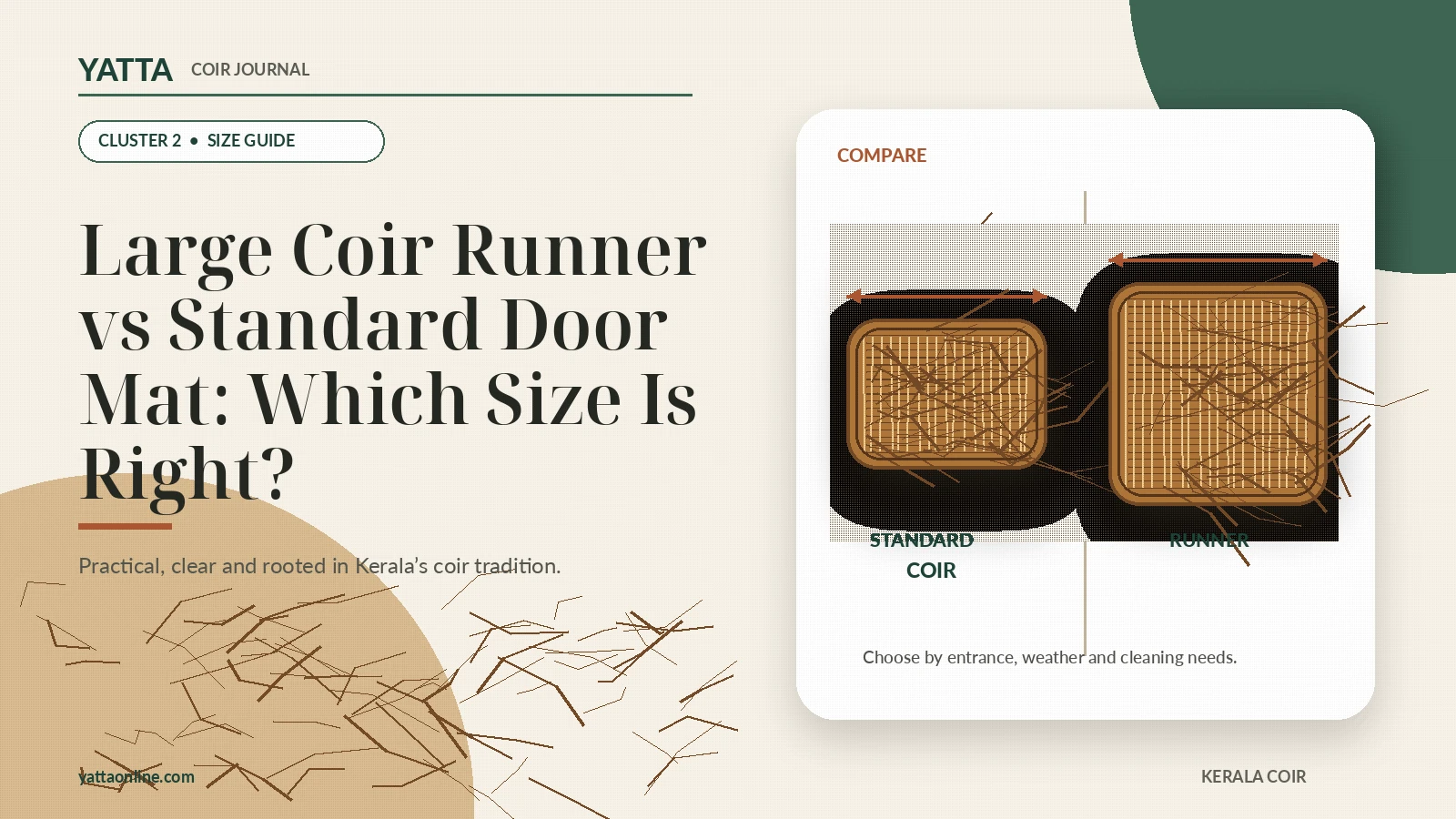
A standard door mat is usually enough for a single doorway or compact apartment entrance. A large coir runner is better for double doors, wide verandahs and entrances where people approach from different positions. The correct size should cover a useful portion of the threshold without blocking the door, extending into a walkway or creating curled edges.
Door mat size affects more than appearance. A mat must be large enough for people to place both feet on it naturally and wipe their shoes before stepping inside. A mat that is too narrow is easy to step around. A mat that is too deep or thick may catch the door.
This guide compares a large coir runner—such as a 40 × 120 cm format—with common standard-sized entrance mats. The terms “large” and “standard” are not universal manufacturing standards, so always rely on actual measurements.
Large coir runner vs standard door mat: key differences
| Factor | Large coir runner | Standard-sized door mat |
|---|---|---|
| Typical role | Spans a wide threshold or double-door entrance | Serves one compact doorway |
| Visual effect | Creates a strong horizontal entrance feature | Looks neat and proportional at a single door |
| Foot placement | Offers more space for multiple steps and different approach angles | Works when users approach through one narrow point |
| Cleaning effort | Heavier and may require more space to shake and dry | Easier to lift, shake and store |
| Best locations | Villas, double doors, verandahs, offices and wide corridors | Apartments, bedrooms, kitchens and single doors |
| Common mistake | Buying without checking depth, door swing and furniture clearance | Choosing a mat so small that people step over or beside it |
| Cost and storage | Usually higher and bulkier | Usually lower and easier to handle |
What is a coir runner mat?
A runner is longer across one direction than a conventional compact door mat. At an entrance, the longer side usually runs parallel to the threshold. A 40 × 120 cm runner therefore provides approximately 120 cm of horizontal coverage and 40 cm of depth, subject to how it is positioned.
The format is useful where the doorway is broad, but it is not automatically correct for every double door. Measure the usable floor area and the full door movement before ordering.
What counts as a standard door mat?
There is no single official standard size used by every manufacturer. Many residential door mats are designed for one doorway and are substantially shorter than a 120 cm runner. Product listings may use labels such as small, medium, large, standard or extra-large differently.
Ignore the size name until you have checked the dimensions in centimetres. A “large” mat from one seller may be smaller than a “standard” mat from another.
How wide should a door mat be?
As a practical design rule, the mat should cover enough of the doorway that it looks intentional and is difficult to bypass. It does not need to match the full wall opening, but it should relate visually to the active door panels.
For a single door, centre the mat on the opening. For double doors, compare the mat length with the combined width of both panels and decide whether you want full-span coverage or a centred accent. Leave clear space around the edges so the mat does not touch walls, planters or door frames.
How deep should an entrance mat be?
Depth determines how many natural steps can land on the mat. A very shallow mat may clean only the front of one shoe. A deeper mat offers more contact, but it also takes more floor space and may interfere with a door that opens outward or inward across the mat.
Mark the proposed footprint on the floor with removable tape. Open the door fully, walk through the entrance and confirm that the size feels natural before buying.
Why a 40 × 120 cm coir runner works for many wide entrances
- The 120 cm length creates broad horizontal coverage.
- The 40 cm depth fits many threshold-style placements without becoming a hallway carpet.
- Multiple people can step on the surface from slightly different approach angles.
- The runner can visually balance double doors or a broad wooden entrance.
- Floral or bordered designs have enough surface area to remain visible.
These advantages apply only when the measurements fit the actual entrance. A 120 cm mat may be too long for a narrow apartment corridor or too short for an unusually wide commercial doorway.
When a standard-sized mat is the better choice
- The doorway is narrow and used by one person at a time.
- The corridor has limited floor space.
- You need to lift and clean the mat frequently.
- The door has low clearance or an unusual swing path.
- You want separate mats at several doors instead of one wide statement mat.
- The entrance layout includes a shoe rack or planter close to the threshold.
Does mat thickness matter?
Yes. A thick mat may provide a substantial scraping surface, but total height must fit below the door. For example, a 15 mm mat requires more clearance than a thin textile mat. Measure at the lowest point of the door sweep, not only at the centre.
Also consider the edge. A clean, flat edge reduces the chance of catching footwear, while a curled or damaged edge should be corrected or the mat replaced.
How to measure your entrance
- Measure the clear width of the active doorway.
- Measure the floor space available from the threshold outward or inward.
- Check the direction and full arc of the door swing.
- Measure the minimum gap beneath the door.
- Note nearby shoe racks, planters, steps and skirting.
- Use removable tape to mark the exact mat dimensions.
- Walk through the taped area to confirm natural foot placement.
- Choose a mat whose actual centimetre dimensions fit inside the tested footprint.
Single door, double door and office recommendations
| Entrance type | Starting point | What to verify |
|---|---|---|
| Compact single door | Standard-sized mat | Door clearance and enough width for both feet |
| Wide single door | Large standard mat or short runner | Visual proportion and corridor space |
| Double doors | Large runner such as 40 × 120 cm | Combined door width and full swing |
| Villa verandah | Large runner | Rain protection, planters and cleaning space |
| Office reception entrance | Wide or commercial mat | Traffic volume, accessibility and edge safety |
| Back or utility door | Compact weather-suitable mat | Moisture exposure and washing needs |
Which size is easier to clean?
A standard mat is easier to lift and shake. A large runner provides more cleaning surface but can be heavier, especially when damp. Before purchasing a large coir mat, make sure you have enough outdoor space to shake it and a ventilated area where it can dry flat.
Final verdict
Choose a large coir runner for wide, double-door or statement entrances; choose a standard mat for compact single doors and easier handling. Actual centimetre measurements, thickness and door clearance matter more than the seller’s size label.
For a full checklist, read how to choose the right coir door mat.
Frequently Asked Questions
Is 40 × 120 cm suitable for every double door?
No. Double-door widths vary. Measure the combined opening, floor depth and door swing before choosing a 40 × 120 cm runner.
Which side of a 40 × 120 cm mat goes along the door?
At most entrances, the 120 cm side runs parallel to the threshold and the 40 cm side provides front-to-back depth. Your layout may require a different orientation, so test the footprint first.
Should a door mat be wider than the door?
It can extend beyond the active door panel when the surrounding floor has space, but it should look proportional and remain clear of walls and obstacles. There is no need to make it wider merely for the sake of width.
Can a thick coir mat stop the door from opening?
Yes. Measure the smallest clearance under the door. The total mat thickness, including backing and edge, must remain below that clearance.
Is a large runner harder to maintain?
It can be heavier to lift, shake and dry. The larger surface may be worthwhile at a wide entrance, but make sure you have a practical cleaning area.
Looking for a Kerala coir mat?
YATTA’s wide coir runner format is designed for entrances that need broader coverage. Compare the listed 40 × 120 cm footprint and 15 mm thickness with your taped floor measurement before purchasing. Explore YATTA home and entrance products.
Editorial note and sources
Prepared by the YATTA Editorial Team for practical buyer education. Mat performance varies with construction, backing, traffic, weather exposure and care. Always follow the instructions supplied with the specific product.