
Quick answer
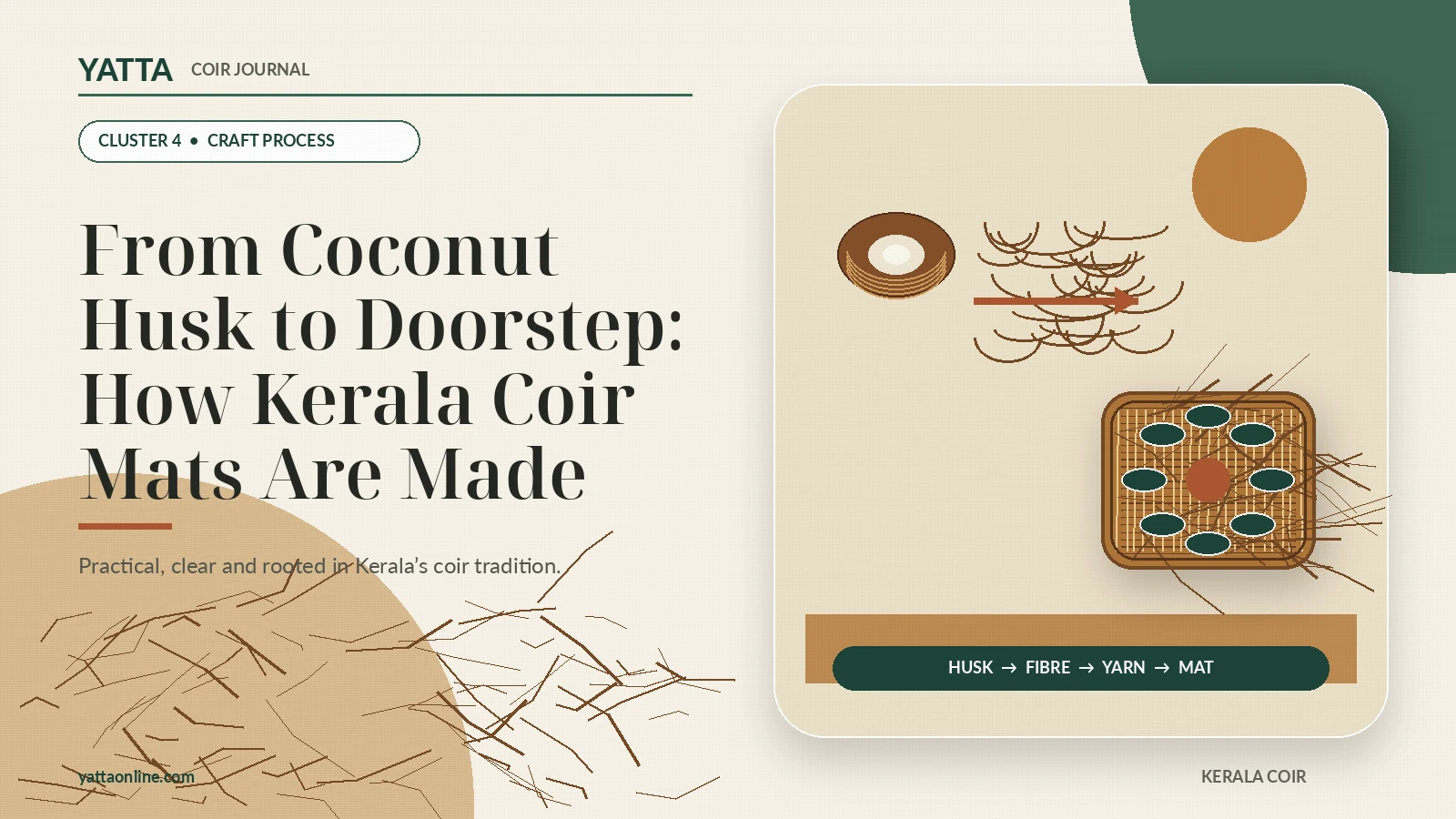
A Kerala coir mat begins with the fibrous husk surrounding a coconut. The husk is collected, processed to separate fibre from pith, cleaned and graded. Depending on the product, the fibre may be spun into yarn, woven on a loom, arranged as a brush surface, printed or stencilled, trimmed and fitted with a backing. The exact process varies by mat construction.
A finished door mat looks simple, but it brings together agriculture, fibre processing, spinning, weaving, finishing and quality control. Kerala’s long association with coconut cultivation and coir work created a specialised production ecosystem in which each stage could develop its own skills and tools.
This guide follows the general journey from coconut husk to a household entrance. It does not imply that every mat is made by the same method. The Coir Board lists mats made on handlooms, power looms or frames, with constructions such as fibre, creel, rod, corridor, Carnatic, loop, mesh, sinnet and rope mats.
Key facts
| Question | Answer |
|---|---|
| Raw material | The fibrous outer husk of the coconut |
| Main usable outputs | Coir fibre, coir pith and shorter fibrous material |
| Intermediate material | Loose fibre or coir yarn, depending on construction |
| Mat-forming methods | Handloom, power loom, frame-based and tufted or brush-forming processes |
| Finishing options | Trimming, printing, stencilling, bevelling, edging and backing |
| Important variation | The process depends on whether the product is woven, brush-type, moulded or backed |
Stage 1: collecting coconut husks
The husk is the thick fibrous layer outside the hard coconut shell. After coconuts are processed for food, oil or other uses, the husk can become a raw material rather than being discarded. Collection systems vary: husks may come from farms, markets, coconut-processing centres or organised supply networks.
Fresh husks contain fibre held together by pith and natural binding material. They cannot simply be cut open and woven immediately. The fibre must first be loosened and separated.
Stage 2: retting or mechanical fibre extraction
Traditional retting
Historically, husks were soaked for an extended period so that the material binding the fibres gradually softened. In Kerala’s water-rich coir regions, retting became closely associated with traditional fibre preparation. The softened husks could then be beaten or mechanically processed to release the fibres.
Mechanical extraction
Modern production may use defibering machinery that crushes and opens the husk to separate fibre more quickly. Mechanical processing helps production take place nearer coconut-growing areas and reduces dependence on long retting cycles. Some supply chains combine mechanisation with later cleaning and grading steps.
The choice of method affects colour, cleanliness, fibre length and intended use. It is better to describe a particular mat as “retted” or “mechanically extracted” only when the supplier confirms the process.
Stage 3: separating fibre from coir pith
When the husk is opened, the useful long fibres are mixed with shorter material and coir pith. Screening, beating, willowing and other cleaning operations help separate these fractions. Coir pith is not necessarily waste: it has established horticultural uses as a growing medium and soil-conditioning material when appropriately processed.
For mat production, fibre consistency matters. Excess dust or hard husk pieces can affect spinning, weaving and the final surface, so processors clean and sort the material according to the needs of the product.
Stage 4: grading and preparing the fibre
Coir fibre can differ in length, colour, stiffness and cleanliness. A compact brush mat may need a different fibre preparation from a woven matting roll or a decorative rope mat. Fibre may therefore be sorted, blended, dried and baled before moving to spinning or mat formation.
| Preparation decision | Why it matters |
|---|---|
| Fibre length | Influences spinning, compactness and surface character |
| Cleanliness | Reduces pith, dust and hard fragments in later operations |
| Moisture level | Affects storage, handling and processing consistency |
| Colour and blend | Influence the natural appearance of the finished product |
| Intended construction | Determines whether fibre is spun, woven, tufted or arranged as brush |
Stage 5: spinning coir yarn
Many traditional coir products use yarn made by twisting fibres together. Spinning may be performed by hand-operated or motorised equipment, while larger units can use automatic spinning systems. The Coir Board’s yarn-formation description notes that baled fibre is cleaned and hard pieces are removed before spinning.
Yarn thickness and twist are selected for the next operation. A mat requiring a bold, rustic structure will not use the same yarn specification as a finer matting weave.
Stage 6: forming the mat
Woven mats
In woven construction, coir yarn is interlaced on a handloom or power loom. The pattern of warp and weft, yarn thickness and loom setting determine texture, density and visual rhythm. Some traditional names describe distinct constructions rather than simply decorative styles.
Brush and fibre mats
For a scraping surface, prepared fibre may be arranged densely so that cut fibre ends form the working face. The Coir Board distinguishes thin-brush creel mats, thick-brush rod mats and compact-brush fibre mats. A buyer should therefore look beyond the word “coir” and examine the actual construction.
Loop, rope and mesh constructions
Other mats create texture through loops, braided or twisted elements, mesh-like openings or rope arrangements. These can offer different appearances and dirt-handling characteristics.
Stage 7: colouring, printing and design
A natural mat may retain the brown tones of coir, or it may be coloured and decorated. The Coir Board notes woven and stencilled designs, while contemporary production also includes printed surfaces and patterned backing systems. Design application must suit the fibre surface: a coarse mat behaves differently from a smooth textile.
Print durability depends on the method, colour system, fibre preparation, weather exposure and cleaning. Avoid claiming that a print is permanently fade-proof unless it has been tested for a defined standard and use condition.
Stage 8: backing, trimming and edge finishing
Backing can help hold a brush surface together and improve stability. Latex, rubber and PVC-based systems are among the constructions found in the market. The Coir Board specifically notes that latex or rubber backing can make mats non-slip, but actual grip still depends on the floor, moisture, dust, mat size and backing condition.
The mat is then cut or trimmed to size. Edges may be bevelled, stitched, bound, moulded or left according to the construction. Large runner mats require particular attention to straightness and flatness because even a small distortion is more noticeable across a longer span.
Stage 9: inspection and packing
- Check dimensions and thickness against specification.
- Inspect the surface for uneven density, hard fragments and visible damage.
- Review print placement and colour consistency where applicable.
- Confirm that backing is attached evenly and that corners lie flat.
- Remove loose manufacturing debris without aggressively disturbing the surface.
- Pack the mat so that sharp folds do not damage its structure.
What makes the process distinctly connected to Kerala?
Kerala’s identity in coir comes from the combination of coconut availability, coastal and backwater production traditions, specialised worker knowledge, cooperative organisation, trading history and institutions based in the state. The Malayalam word kayar or kayaru, meaning cord or something twisted, is also identified by the Coir Board as the linguistic origin of the English word “coir”.
Learn more in the history of Kerala’s coir-making tradition and why Kerala is famous for coir products.
Frequently Asked Questions
Are all Kerala coir mats handmade?
No. Coir mats can be made on handlooms, power looms or frames, and some constructions use mechanised fibre extraction, spinning, tufting, printing or backing. “Handmade” should be used only when the actual production supports the claim.
Is a coir mat made from the coconut shell?
It is made from fibre in the husk surrounding the hard shell, not from the shell itself.
What happens to coir pith?
Coir pith can be processed for horticultural uses, including growing media and soil-conditioning applications. Its suitability depends on processing and quality requirements.
Why are some coir mats much denser than others?
Density varies with fibre grade, construction, thickness and the method used to secure the working surface. A compact fibre mat and a loop mat are intentionally different products.
Does PVC backing make a mat waterproof?
Not automatically. Backing may help hold the mat and reduce movement, but the fibre surface can still become wet. Use the product according to its stated weather and care instructions.
Explore the finished YATTA coir runner
See how traditional coconut fibre is presented in a practical modern entrance format. Review the current YATTA coir mat size, thickness, backing and design details in the YATTA shop.
Editorial note and sources
Prepared by the YATTA Editorial Team as an educational overview of Kerala coir heritage, materials and production. Individual workshops and factories may use different equipment, fibre grades, dyes, backing systems and finishing methods. Product-specific claims should be verified against the current YATTA specification before publication.
- Coir Board, Government of India: meaning and origin of the word coir
- Coir Board, Government of India: coir processing overview
- Coir Board, Government of India: coir mat types and constructions
- Coir Board, Government of India: formation of coir yarn
- Coir Board, Government of India: International Coir Museum, Alappuzha
- Ministry of MSME Annual Report 2025–26: coir industry overview