
Quick answer
Coir is better for scraping dry mud, sand and grit; microfibre is better for absorbing moisture and collecting fine dust from relatively clean footwear. A coir mat suits the outer covered threshold, while a washable microfibre mat often works better just inside the door.
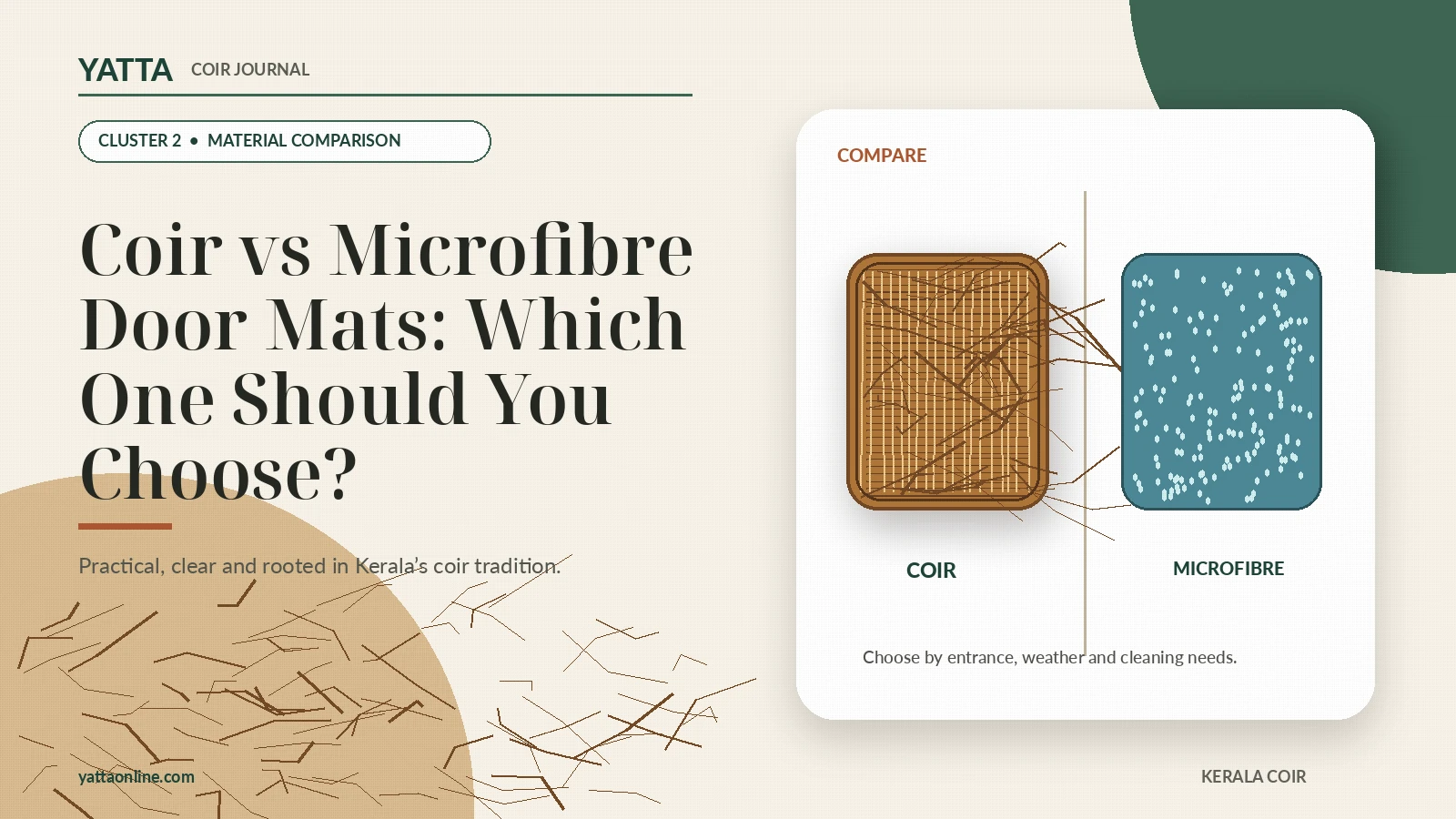
Coir and microfibre mats can both reduce the dirt that reaches your floor, but they work in different ways. Coir uses stiff coconut fibres to brush debris from shoe soles. Microfibre uses very fine synthetic fibres to create a soft, absorbent surface that holds moisture and fine particles.
Understanding this difference helps you avoid a common buying mistake: expecting one mat to scrape heavy dirt, absorb water, dry quickly and remain easy to wash in every location.
Coir vs microfibre door mat: key differences
| Factor | Coir mat | Microfibre mat |
|---|---|---|
| Primary action | Scrapes and loosens dry debris | Absorbs moisture and traps fine dust |
| Texture | Coarse and firm | Soft, dense or chenille-like |
| Best position | Covered outer entrance or threshold | Indoor side of the entrance |
| Water handling | Should not remain saturated | Often designed to absorb water; washability varies |
| Cleaning | Shake, brush and vacuum | Many are machine washable, but follow the label |
| Appearance | Natural, rustic and printed | Soft, modern and available in many colours |
| Common limitation | Shedding and slower drying after soaking | Can become saturated and may not scrape thick dried mud effectively |
| Typical use | First cleaning stage | Final moisture and fine-dust stage |
How does a coir mat clean shoes?
A coir mat is a mechanical scraper. The firm fibres press into the grooves of footwear and dislodge dry soil. The user needs to wipe or scrape each foot across the surface for the mat to work effectively.
Coir is therefore valuable at dusty entrances, after gardening or in locations where footwear carries sand and small grit. It is less suited to functioning as an absorbent bath mat.
How does a microfibre mat work?
Microfibre mats use many thin synthetic filaments to create a large surface area. Depending on the weave, the mat can absorb water droplets and hold fine dust until cleaning. Soft looped microfibre mats are common inside kitchens, bathrooms and apartment entrances.
The surface is comfortable underfoot, but a soft pile does not always reach into deeply patterned shoe soles. Thick mud should be removed before stepping on an absorbent indoor mat.
Which mat is better for rainy footwear?
Microfibre is generally better at absorbing the remaining water from footwear, provided the mat is intended for entrance use and is cleaned before it becomes saturated. However, it is not a substitute for managing heavy mud or direct rain exposure.
At a covered entrance during the monsoon, a practical sequence is:
- Use an outdoor drainage or rubber mat for very wet mud if the doorway is exposed.
- Use coir under cover to scrape grit and dried soil.
- Use microfibre inside to collect remaining moisture and fine dust.
Not every home needs three mats. The sequence simply shows that scraping and absorption are different jobs. Select the stages that match your doorway.
Which mat is easier to wash?
Many microfibre mats are sold as machine washable, making them convenient for indoor use. Still, the label matters: heat, bleach, fabric softener or high-speed drying can affect some backings and fibres.
Coir is normally maintained through dry methods. Shaking, brushing and vacuuming remove loose dirt without soaking the fibre. If a coir mat becomes wet, dry it fully before returning it to the floor.
Which mat is better for homes with children or older adults?
A mat should not curl, bunch or slide regardless of material. Microfibre mats can feel softer, but light mats may move on polished tile. Coir mats are firmer, although worn edges or unsuitable backing can also create a trip risk.
Look for a flat profile, appropriate backing and enough clearance under the door. Test every new mat on the actual floor rather than relying only on a “non-slip” product description.
Which mat is better for pets?
Coir can remove dry outdoor dirt from paws, but pets may scratch or pull the fibres. Microfibre is softer and can absorb moisture from paws, although it may require frequent washing and drying. For muddy pets, keep a washable towel nearby instead of expecting one entrance mat to handle all cleaning.
Choose coir when…
- Your main problem is dry dust, sand, grit or dried mud.
- The mat will sit in a sheltered entrance.
- You prefer a natural coconut-fibre look.
- You want a firm surface that encourages active shoe scraping.
- You can maintain the mat through shaking and brushing.
Choose microfibre when…
- Your main problem is light moisture and fine indoor dust.
- The mat will remain inside rather than in direct weather.
- You prefer a soft surface and frequent washable care.
- You need a mat near a kitchen, bathroom or apartment entrance.
- You are prepared to wash and fully dry it before reuse.
Final verdict
Coir scrapes; microfibre absorbs. For a dry, covered threshold, coir is usually the stronger first line of defence. For the indoor side of the doorway, microfibre can collect remaining moisture and fine particles. Using each material for its intended job produces better results than expecting one to do everything.
Read how to clean a coir mat and the complete coir mat guide before selecting your entrance setup.
Frequently Asked Questions
Is microfibre better than coir?
It is better for moisture absorption and soft indoor use. Coir is better for scraping dry grit and mud. The better material depends on the entrance problem you need to solve.
Can I use a microfibre mat outdoors?
Only when the manufacturer specifically recommends outdoor use. Many microfibre mats are designed for protected indoor spaces and may remain wet if exposed to rain.
Can a coir mat absorb water?
Coir fibre can take up moisture, but a door mat should not be treated as an absorbent bath mat. Prolonged wetness can make it slow to dry and may reduce its useful life.
Which mat is better for a tiled apartment entrance?
A backed coir mat can work outside a covered apartment doorway, while a low-profile microfibre mat can work inside. Test the backing on the tile and check door clearance.
Do microfibre mats trap odours?
Any absorbent mat can develop odour when it remains dirty or damp. Wash it according to the label and dry it completely before placing it back on the floor.
Looking for a Kerala coir mat?
For a covered entrance where dust and grit are the main concerns, a broad coir surface gives people enough room to wipe both feet before entering. Explore YATTA home and entrance products.
Editorial note and sources
Prepared by the YATTA Editorial Team for practical buyer education. Mat performance varies with construction, backing, traffic, weather exposure and care. Always follow the instructions supplied with the specific product.