
Quick answer
Coir is firmer and better for scraping dirt from footwear, while jute is softer and usually better suited to decorative indoor areas with lighter traffic. For a main entrance, coir is normally the more practical natural fibre. For a bedroom, living room or protected decorative space, jute may feel more refined.
Coir and jute are both plant-based fibres used in mats, rugs, baskets and home furnishings. Because both often appear in shades of tan and brown, shoppers may assume that they perform in the same way. They do not.
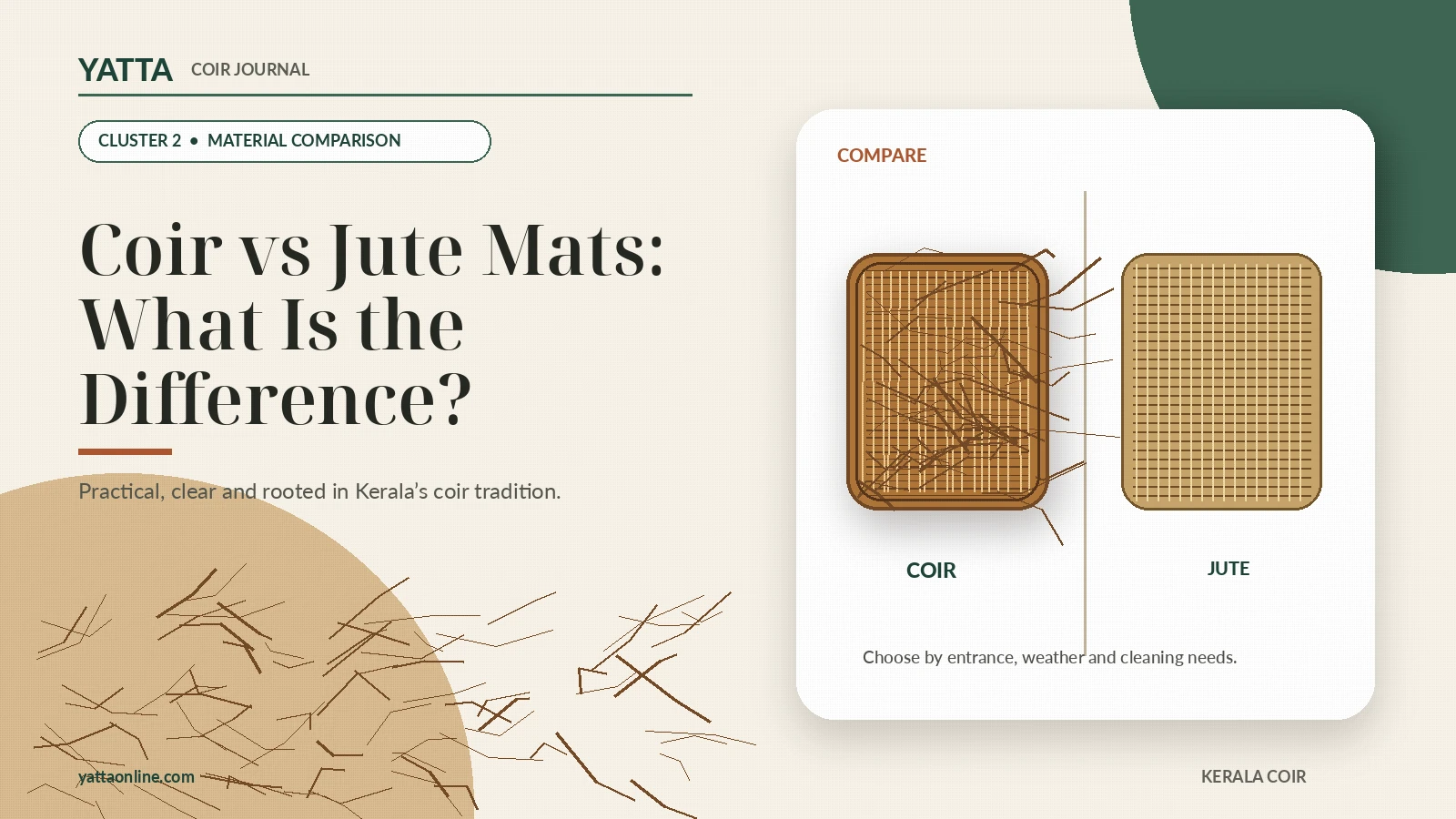
Coir comes from the fibrous husk around a coconut. Jute is a bast fibre obtained from the stem of jute plants. Their different sources create different textures: coir is coarse, springy and brush-like, while jute is generally softer and more textile-like.
Coir vs jute mat: key differences
| Factor | Coir mat | Jute mat |
|---|---|---|
| Raw material | Fibre from coconut husk | Fibre from the stem of the jute plant |
| Texture | Coarse, firm and brush-like | Softer, smoother and woven |
| Primary use | Doorways and dirt-scraping zones | Decorative indoor rugs and low-soil areas |
| Dirt removal | Better at loosening dry mud and grit | Better for light dust than heavy scraping |
| Comfort underfoot | Firm and rough | Softer and more comfortable |
| Moisture preference | Best protected from prolonged saturation | Usually best kept dry and indoors |
| Visual style | Rustic, natural and entrance-focused | Warm, woven and room-focused |
| Typical limitation | Fibre shedding and a rougher surface | Can absorb moisture and stain; less effective on muddy footwear |
What is coir?
Coir is the strong fibrous material found in coconut husks. The firm fibres can be spun, woven, tufted or bonded into mats and matting. Coir entrance mats are valued for their ability to brush against shoe soles and dislodge dry debris before it reaches the interior floor.
The material’s natural stiffness is an advantage at a doorway but makes it less suitable where people expect a soft rug. Coir also sheds some loose fibres, especially when new or when the surface experiences regular abrasion.
What is jute?
Jute is a long plant fibre commonly spun into yarn and woven into fabrics, sacks, rugs and home accessories. A jute mat has a softer hand feel and a flatter textile appearance than most coir door mats.
That softness makes jute attractive for living rooms, bedrooms and protected corners. It is not normally the first choice for scraping thick mud from outdoor footwear. It also needs protection from persistent moisture because plant-fibre rugs can become difficult to dry and may lose their shape or develop marks.
Which material removes more dirt from shoes?
Coir is generally the stronger scraper. Its short, firm fibres act like a brush and reach into the textured parts of shoe soles. This is why coir is closely associated with door mats rather than room rugs.
Jute can collect light dust, but its woven surface is smoother. Aggressive shoe scraping may also wear a decorative jute weave more quickly. Use jute where the mat’s main role is visual warmth or light floor protection rather than heavy cleaning.
Which mat is better for a front door?
For a covered front door, coir is usually the better choice. It is purpose-suited to dry dirt and frequent shoe contact. A backing may help reduce movement and keep loose particles from reaching the floor beneath.
A jute mat can be used inside a completely protected entrance, but it is better treated as an interior rug. It should not be expected to perform like a bristled coir scraper.
Which mat is better for indoor décor?
Jute is often the better decorative indoor choice. It works well beneath a coffee table, beside a bed or in a low-moisture seating area. The weave creates a calm, natural look without the roughness of a coir surface.
Coir can still be decorative at the threshold. Printed floral patterns, welcome messages and bordered runners can make the entrance look intentional while retaining dirt-scraping performance.
Which natural fibre is easier to maintain?
Neither fibre should be cleaned like a plastic mat. Routine dry cleaning is important for both. Coir is commonly shaken, brushed or vacuumed. Jute is often vacuumed gently and spot-cleaned according to its care label.
Water is the main caution. Do not soak either mat unless the manufacturer explicitly permits it. When spot cleaning is necessary, use minimal moisture and dry the mat thoroughly. Moisture trapped beneath a natural-fibre mat can also affect the floor.
Which one is more suitable for Indian homes?
The answer depends on the room:
| Location | Better starting choice | Reason |
|---|---|---|
| Covered main entrance | Coir | Stronger dry-dirt scraping |
| Exposed rainy doorway | Neither by default | Consider a weather-resistant drainage mat or a protected two-mat setup |
| Apartment corridor entrance | Coir | Useful for dust and everyday footwear |
| Living room | Jute | Softer decorative weave |
| Bedroom | Jute | More comfortable underfoot |
| Utility or wash area | Weather-resistant synthetic or rubber | Better suited to repeated moisture |
Choose coir when…
- The mat will sit at a covered entrance.
- You need to scrape dust, grit and dry mud from footwear.
- A rustic coconut-fibre texture suits your décor.
- You want a printed or plain door mat rather than a soft room rug.
- You can shake and dry-clean the mat regularly.
Choose jute when…
- The location is indoors and protected from moisture.
- Comfort and woven texture matter more than shoe scraping.
- You want a natural-looking rug for a bedroom or living room.
- Traffic is relatively light and footwear is not heavily soiled.
- You are prepared to follow careful spot-cleaning instructions.
Final verdict
Coir and jute are not direct substitutes. Coir is an entrance-working fibre; jute is usually an interior-decor fibre. Choose coir for the covered threshold and jute for the room beyond it.
For more help with coir construction, backing and placement, see the Kerala coir mats guide.
Frequently Asked Questions
Is coir the same as jute?
No. Coir is obtained from coconut husks, while jute fibre comes from the stem of the jute plant. Coir is generally coarser and more suitable for scraping footwear.
Can a jute rug be used as a door mat?
It can be placed at a dry interior doorway, but it may not remove heavy dirt effectively. A jute rug should be kept away from frequent rain, mud and standing moisture.
Which mat sheds more?
Both natural fibres can release loose material, but coir door mats commonly show visible fibre shedding during early use. The amount varies by construction, quality and traffic.
Which is softer: coir or jute?
Jute is generally softer and smoother. Coir is intentionally firm and rough because its main function is scraping footwear.
Can coir and jute mats be washed?
Do not assume either mat is washable. Follow the specific care label. Dry cleaning methods and minimal spot cleaning are usually safer than soaking a natural-fibre mat.
Looking for a Kerala coir mat?
A coir mat is the practical natural-fibre choice for a covered doorway. Select a size that spans enough of the entrance for people to step on it naturally. Explore YATTA home and entrance products.
Editorial note and sources
Prepared by the YATTA Editorial Team for practical buyer education. Mat performance varies with construction, backing, traffic, weather exposure and care. Always follow the instructions supplied with the specific product.