
Quick answer
Choose coir when you want strong dry-dirt scraping and a natural entrance look. Choose rubber when the mat will face frequent rain, standing moisture or heavy wet-foot traffic. A backed coir mat can improve stability, but the best choice still depends on whether your entrance is covered, how much mud it receives and how you prefer to clean the mat.
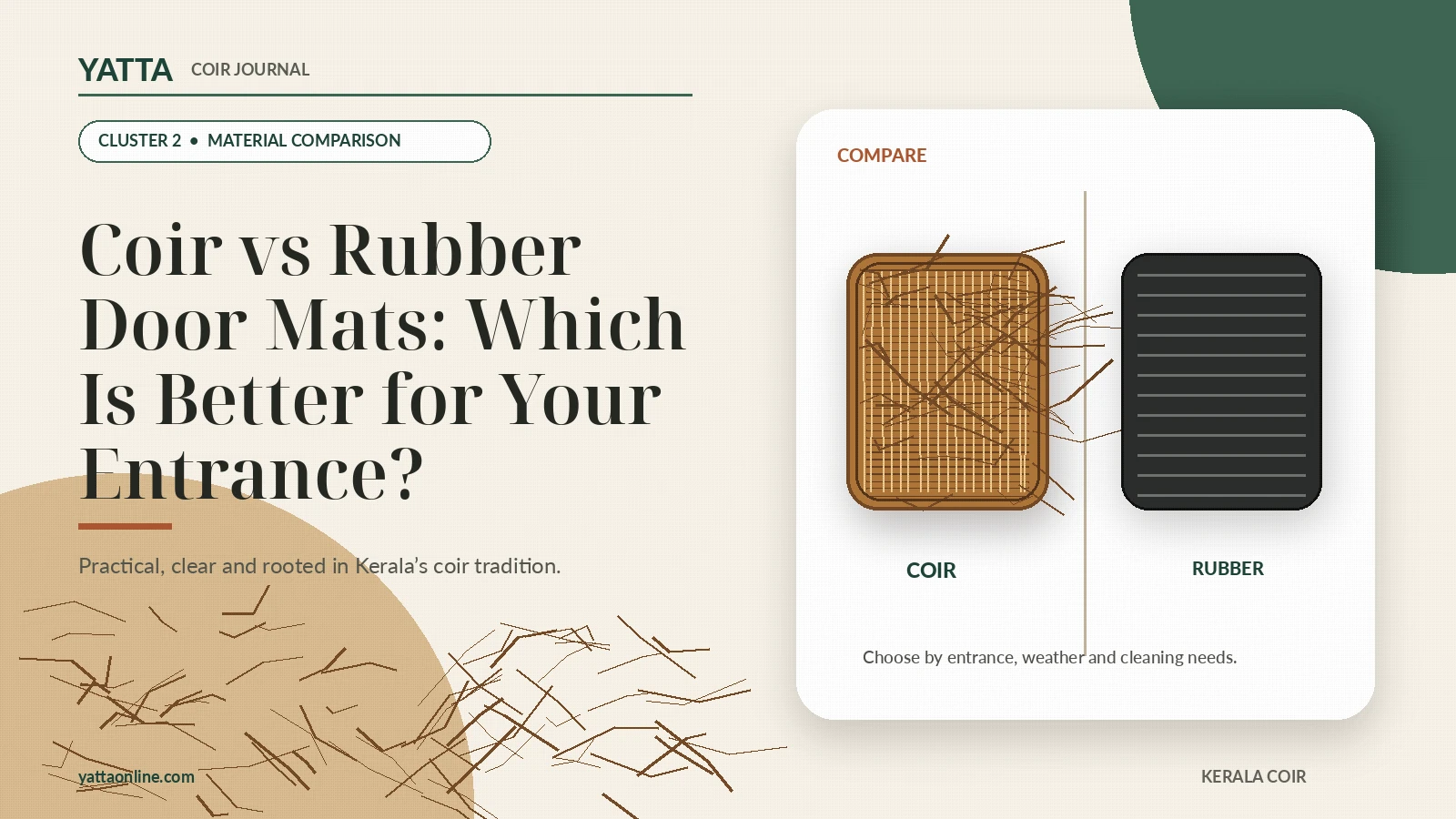
Coir and rubber are two of the most common materials used for entrance mats, but they solve slightly different problems. Coir is a firm plant fibre extracted from coconut husks. Rubber mats are moulded or textured from natural or synthetic rubber compounds. Both can help reduce the dirt carried into a home, yet their scraping action, moisture behaviour, appearance and maintenance are different.
This comparison explains those differences so that you can choose a door mat based on your entrance rather than selecting only by colour or price.
Coir vs rubber door mat: key differences
| Factor | Coir door mat | Rubber door mat |
|---|---|---|
| Best at | Scraping dry soil, grit and debris from footwear | Handling wet entrances and providing a washable textured surface |
| Appearance | Warm, natural and traditional | Functional, contemporary or industrial |
| Moisture exposure | Best in a covered or sheltered position | Usually better suited to frequent wet exposure, depending on design |
| Cleaning | Shake, brush or vacuum; avoid prolonged soaking unless the care label permits it | Many designs can be rinsed, but always follow the manufacturer’s instructions |
| Surface feel | Firm and fibrous | Flexible, ridged, perforated or patterned |
| Common limitation | May shed fibres and can retain moisture if repeatedly saturated | May look less decorative and some types can become hot or age outdoors |
| Ideal buyer | Someone prioritising scraping and a natural entrance aesthetic | Someone prioritising wet-weather practicality and easy rinsing |
What is a coir door mat good at?
A coir mat works mainly through its coarse brush-like surface. As shoes move across the fibres, the mat helps loosen dry mud, sand and grit. This makes coir particularly useful at entrances where the main problem is dust and dry outdoor debris.
Coir also has a distinctive natural appearance. The warm brown fibre suits wooden doors, traditional Kerala homes, apartments, villas and entrances decorated with plants or natural materials. Printed and stencilled designs can add colour without hiding the fibrous texture.
However, coir is not the same as a waterproof plastic mat. A coir mat placed where it is repeatedly soaked may stay damp, become heavier and age faster. Positioning it under a porch, canopy or covered corridor generally gives it a more suitable working environment.
What is a rubber door mat good at?
Rubber mats are often selected for wet, muddy or high-traffic locations. Raised ridges, holes and textured patterns can help scrape footwear, while open designs allow water and loose dirt to move below the standing surface. Many rubber mats are also easier to rinse than fibre mats.
The category is broad. A thin decorative rubber mat, a heavy commercial mat and a perforated outdoor mat will not perform identically. Check the product’s weight, drainage pattern, edge profile and recommended location before purchasing.
Which mat is better for the Indian monsoon?
For an entrance directly exposed to monsoon rain, a rubber or drainage-style mat is usually the more practical single-mat option. It is designed around water exposure and can often be rinsed after muddy use.
For a covered entrance, coir may still work well because it removes grit before people step indoors. Some households use a two-stage setup: a rubber mat outside the exposed area for wet mud and a coir mat inside the covered threshold for final scraping. This arrangement separates moisture management from dry-dirt removal.
Which mat is safer on smooth floors?
Neither material should be assumed to be completely slip-proof. The mat must lie flat, match the floor and remain free from trapped dust or water. Rubber mats often have naturally high-friction undersides. Coir mats may use latex, rubber or PVC-style backing to reduce movement.
Backing improves stability, but it does not guarantee that a mat will never slide. Test the mat after placement, keep the floor beneath it clean and replace it if the backing curls, cracks or loses grip.
Which one is easier to clean?
Cleaning a coir mat
- Take the mat outdoors and shake out loose dust.
- Tap or brush the reverse side to release trapped grit.
- Vacuum the top using suitable suction without aggressively pulling the fibres.
- Spot-clean only when necessary and allow the mat to dry fully in a ventilated place.
- Read the complete coir mat cleaning guide before using water or detergent.
Cleaning a rubber mat
- Shake or sweep away loose material.
- Rinse only if the product instructions allow it.
- Use mild cleaning solution where appropriate.
- Dry the mat and the floor beneath it before replacing it.
Which one looks better at a home entrance?
This is mainly a design decision. Coir gives an entrance a warmer, more handcrafted appearance. Rubber can look cleaner and more minimal, especially in modern apartments, utility areas and office entrances. A floral printed coir runner can become part of the entrance décor, while a plain black rubber mat usually stays visually secondary.
Choose coir when…
- Your entrance is covered or mostly protected from direct rain.
- Dry dust, soil and grit are the main problems.
- You prefer a natural coconut-fibre appearance.
- You want a printed, floral or traditional entrance design.
- You are comfortable with routine shaking, brushing and gradual fibre shedding.
Choose rubber when…
- The mat will receive frequent rain or wet footwear.
- You want a mat that can generally be rinsed more easily.
- Drainage and wet-weather grip matter more than a natural-fibre look.
- The location is a utility entrance, balcony, workshop or exposed doorway.
- You need a heavy-duty design for frequent traffic.
Final verdict
Coir is the better choice for natural style and dry-dirt scraping; rubber is usually the better choice for persistent wet conditions and easy rinsing. For many Indian homes, the most effective answer is not to declare one material universally superior. It is to match the mat to the exposure level of the doorway.
Before choosing a size or construction, read our complete Kerala coir mats guide and door mat buying guide.
Frequently Asked Questions
Is a coir mat waterproof?
Coir fibre should not be treated as fully waterproof. A coir mat may tolerate occasional moisture, but repeated soaking can slow drying and shorten its useful life. A covered entrance is normally more suitable.
Can I place a coir mat over a rubber mat?
You can use separate mats in sequence, but stacking one directly on another may create an uneven surface or movement. A safer setup is to place the wet-weather mat outside and the coir mat farther inside on a clean, level floor.
Does a rubber-backed coir mat combine both benefits?
Backing can reduce movement and protect the mat’s structure, but the coir surface still behaves like fibre. It does not turn the whole mat into a washable outdoor rubber mat.
Which mat is better for pets?
That depends on the pet and location. Coir can catch dry dirt from paws, while rubber is often easier to rinse after wet or muddy use. Some pets may also scratch or pull loose coir fibres.
How often should an entrance mat be replaced?
Replace it when the surface no longer scrapes effectively, the backing is damaged, the edges curl or the mat cannot be cleaned and dried properly. Traffic and weather exposure affect the replacement interval.
Looking for a Kerala coir mat?
For a wide, covered entrance, consider a large coir runner with a firm scraping surface and a stabilising backing. Check the final product dimensions against your doorway before ordering. Explore YATTA home and entrance products.
Editorial note and sources
Prepared by the YATTA Editorial Team for practical buyer education. Mat performance varies with construction, backing, traffic, weather exposure and care. Always follow the instructions supplied with the specific product.